
Getting Found Isn’t Actually the Point of SEO


A red pencil checking off boxes on a printed checklist

Imagine you’re at a farmers market, walking through the vendors. You walk up to one and fall in love with their tomatoes, but they don’t let you buy any. First, you have to fill out a form and wait for someone to call and ask how many tomatoes you’d like. The entire time, you don’t know the price per pound or whether the tomatoes you’ll end up getting are the same as the ones you saw at the market. You get overwhelmed. You just want tomatoes for dinner tonight, so you move on. You find another stand with slightly bruised tomatoes, but you know how much they’ll cost and you can take them home today.

Now imagine someone searches for something on Google, lands on your website, and decides you might be a fit. They go to book an appointment and find they can’t. They can only request one: fill out a form and wait for someone to get in touch. There’s no word on when, or whether anything is even open. They could wait, or they could go back to the search results and try the next link. When people hear “SEO,” they think it means showing up on Google, and that’s it. Being found online is part of it, but that’s only half the battle. The visitor still has something to get done on your website, and part of SEO is making sure a warm lead, like someone browsing tomatoes, turns into a conversion.

I recently ran an office poll on what people would do if they couldn’t book online. Over half said they’d find another option that would let them, myself included. We talked it over and agreed on why: we weren’t in a hurry for the appointment. We just wanted it done so we could cross it off the to-do list. An appointment a month out still gives someone the resolution they want today. It goes on the calendar and they move on. A form that says “we’ll be in touch” leaves the loop open. Now they’re waiting on a reply, wondering whether the time will work, and whether they should be looking for a backup option.

That’s easy to miss from inside a business. You know who reads the form and how scheduling works. The visitor knows none of that unless you tell them. To a stranger, the website is the first impression of how you operate. If getting an answer is hard before they hire you, they may wonder how hard it will be afterward. That isn’t always fair, but it’s the only evidence they have.


Read More →

Your Brain Is a Muscle, and AI Isn’t Your Personal Trainer


A hand holding up a lightbulb drawing bursting with bright watercolor splashes

Nobody skips leg day for six months and expects to still be able to squat their max. And yet, that’s basically what a lot of businesses are doing to their brains right now, except instead of legs, it’s the part responsible for coming up with a decent idea without being handed one first.

Here’s the thing about creativity: it’s not a personality trait you either have or don’t. It’s a muscle. The more you use it — wrestling with a blank page, sitting with a bad first draft, forcing yourself to come up with option four when options one through three were mediocre — the stronger it gets. And like any muscle, the second you stop using it, it doesn’t stay the same. It atrophies.

AI is a fantastic spotter. It is a terrible substitute for actually lifting the weight.

The businesses I worry about aren’t the ones using AI. It’s the ones who’ve quietly stopped doing the first draft themselves, period. Every caption starts with a prompt. Every idea starts with “what should I post about.” Every hard question gets outsourced to the tool before the brain even gets a shot at it. It’s convenient right up until the day the AI is down, or the answer it gives is wrong, or a client asks a question that requires actually knowing your own business, and there’s a very awkward silence where a muscle used to be.


Read More →

Timelessness & Awe


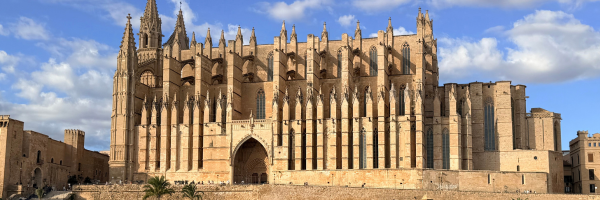
Palma Cathedral in Mallorca, its Gothic spires against a blue sky with scattered clouds

If something is going to come across as timeless, it will probably take a bit of time to create.

Last month I was in Palma on the island of Mallorca. While we were there, we visited the famous Palma Cathedral. As my friends and I wandered around in awe of its majesty, one of us asked, “Hey, what year do you think this was built?” The answer isn’t one year or even a few. Construction began in 1229, and it wasn’t finished until 1601. It took 372 years to complete! And today, 425 years after its completion, 1.2 million people visit the cathedral every year.

Every day I think about artificial intelligence and how it can make us better and more efficient. And there is no debate: it is making us faster. But faster is only better when the output is just as good as, or better than, if a slower human did it themselves. We’ve all become way too familiar with the reality of AI slop. It can swiftly and easily ruin a brand and reputation.

A recent headline grabbed my attention. The gist of the article was that trust can’t keep up with AI, so people are still very important to business. This is encouraging news for the people worrying about AI taking jobs. And it’s also important to remember as a small business trying to keep up with technology. We need to embrace AI, but remember the purpose of everything that we are creating. We’re not creating something for the sake of checking off a box. We’re still creating something for humans.


Read More →

This Month's 3 Things

Browse By Category

Get the 3 Things Newsletter

Once a month, get three short reads on marketing, web, and running a smarter business.