
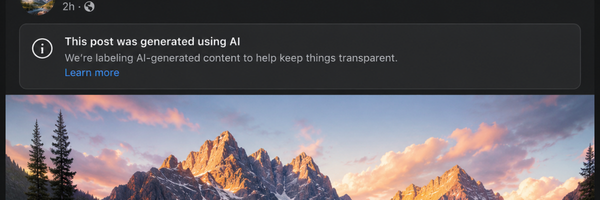
It feels like everyone I know right now is using AI for something: writing captions, brainstorming content ideas, even drafting entire social posts. Which is fine (I have my own opinions, but they’re exactly that, opinions, and I’m keeping them to myself until happy hour). It’s a tool, like a camera or a scheduling app, or that one employee who’s great at brainstorming but shouldn’t be allowed near “send.” But there’s a line a lot of businesses are stepping over without realizing it, and clients and customers can feel it even when they can’t name it.
That line is the difference between AI-generated and AI-assisted content.
AI-generated means you typed a prompt, copied the output, and hit publish, three exclamation points and all. No edits, no fact-check, no “does this actually sound or look like us.”
AI-assisted means the tool helped you get unstuck, organize a thought, or clean up a draft, but a real person still shaped the final thing before it went out under your name.
Here’s the thing: your clients aren’t scanning your posts for the words “written by AI.” They’re reading for whether it sounds and looks like you. The second a caption feels generic, oddly formal, or like it was written by someone who’s never actually met you, trust takes a small hit, even if they can’t articulate why. It’s the content equivalent of a hug from someone who’s clearly checking their watch.
So where’s the boundary?
- Use AI for the blank page, not the final word. Let it help you brainstorm five headline options or restructure a clunky paragraph. Don’t let it be the last set of eyes on anything with your name attached to it. It’s an intern, not a co-owner.
- Add what AI can’t manufacture. A real customer quote. A detail from a job you actually did last week. Your own opinion on something in your industry (see: happy hour, above). That’s the stuff that makes a post yours instead of anyone’s.
- Have an answer ready if someone asks. You don’t need to disclose your workflow on every post, but you should be able to say, honestly and without flinching, how much of it was you. If that answer would embarrass you, that’s a sign to adjust the process, not to just get better at flinching.
AI-assisted content, done well, can actually be faster and often better than what you’d produce alone. AI-generated content, done carelessly, quietly tells your clients you weren’t in the room. Same tool, very different outcome, kind of like the difference between using a stand mixer and just serving people the bag of flour in a bakery.
But the boundary isn’t only about quality. It’s about perception, and perception is where trust actually lives.
Here’s what I mean: most clients aren’t fact-checking your workflow. They’re not asking, “did a human write this?” They’re doing something quieter and harder to reverse. They’re forming a gut feeling about whether your business is paying attention. AI-generated content, even when it’s technically accurate, tends to read as a business on autopilot. And once a client suspects autopilot, they start wondering what else is just a box being checked. Is anyone actually reading my emails? Am I a real relationship or an account number? Am I about to get “Hi [FIRST_NAME]”-ed?
That suspicion doesn’t need to be confirmed to do damage. It just needs to be possible.
Worth a quick side note here, because it comes up constantly: not every em dash is a confession. Somewhere along the way, the internet decided that clean grammar, tidy transitions, and the occasional well-placed em dash are secret AI tells. They’re not — they’re just what happens when someone actually learned to write, possibly from an AP or Chicago Manual of Style handbook that’s been sitting on their desk since a college composition class. Good writing existed before AI did. Don’t let the paranoia convince you (or your clients) that a properly punctuated sentence is suspicious. Sometimes a semicolon is just a semicolon.
A few things worth sitting with as you think about your own boundaries:
- Clients don’t need a disclosure, they need evidence. You don’t have to caption every post with “written with AI assistance” (please don’t, that’s its own kind of cringe). What you do need is content that keeps proving, post after post, that a real person is behind it: specific details, a consistent voice, the occasional charming imperfection a prompt would never think to generate.
- The businesses people trust most are the ones who feel findable. If a client can tell there’s a real person shaping what they see, they trust there’s a real person they can reach when something goes wrong. AI-generated content quietly erodes that sense of reachability, even if your phone number is still sitting right there in the bio, patiently waiting to be believed in.
- Being asked “did you use AI for this?” shouldn’t feel like a gotcha. If your honest answer is “yes, to help me brainstorm, but I wrote and fact-checked the final version,” that’s a good answer. Say it plainly. Clients respect the boundary more than they respect the illusion that there isn’t one, and nobody’s handing out trophies for pretending you typed 700 words solo at 6am.
The businesses that get this right aren’t the ones avoiding AI altogether, and they’re not the ones hiding how much they use it. They’re the ones who’ve decided, on purpose, where the human has to stay in the loop, and who are comfortable telling you exactly where that is.
That’s the real boundary. Not “AI or no AI,” but “where does the human stay non-negotiable.” Everything else is just a very fast, occasionally overconfident intern.