
Most businesses know what they want their website to do: generate leads, support growth, attract better-fit opportunities. But a site can line up with internal business goals and still feel off to the people landing on it.
That usually points to a more basic question that has not been answered clearly enough: who is the site actually built for? Not who the business wants to attract someday. Not who leadership hopes will matter more in the next stage of growth. Who is most likely to arrive now, and can that person quickly find what they came for?
Ambition is not the problem. Sequencing is.
When growth goals pull the site off course
A business planning its next stage of growth often has a new or expanded audience in mind: larger accounts, higher-value work, stronger partnerships, better recruiting, or more authority in the market. Those are legitimate goals, and a website should eventually reflect them.
The problem is what happens when those future-stage priorities start driving the site before the present-stage audience is well served.
The homepage starts speaking to the company’s next audience before it has finished serving the audience already arriving. Navigation makes room for the people the business wants more of later. Messaging gets polished in ways that sound more sophisticated internally, but less direct to the person trying to answer a simple question:
Do you solve the problem I came here with?
That mismatch creates doubt fast.
Visitors do not experience websites as strategy documents. They experience them as signals: Am I in the right place? Does this business understand what I need? Can I quickly find the thing I came for?
When those answers are unclear, people usually do not work hard to resolve the ambiguity. They leave.
A better website does not always mean a broader website
This usually does not happen because the business is confused. It happens because the business is ambitious. Leadership is thinking about where growth needs to come from next, which is exactly what leadership should be doing. But those priorities can start changing the website in ways that quietly weaken its usefulness.
For example, a regional service business may want to attract larger national accounts, so the homepage starts leading with scale, partnerships, authority, and enterprise credibility. But most visitors may still be local or mid-market buyers trying to understand services, fit, pricing signals, service area, and whether the company handles their specific problem.
The site may look more mature. It may sound more impressive. It may even be technically sound. But it has become less useful to the people most ready to take action.
That is the danger. The website improves in a way that satisfies internal ambition while creating friction for the audience currently generating demand.
You can serve multiple audiences. But hierarchy matters.
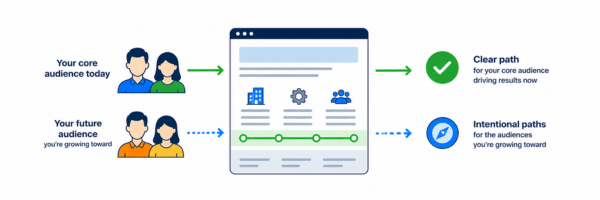
A website does not have to choose between its current audience and its aspirational one. Both can have a place. The question is whether each audience has a clear path through the site, or whether one is quietly crowding out the other.
A current customer landing on a homepage dominated by enterprise credibility signals, expansion language, or recruiting content has to work harder to find what they need. An aspirational prospect landing on a site still organized around entry-level services may not see themselves reflected either.
Neither outcome is good. And both can happen on the same website at the same time.
The fix is not to strip ambition out of the site. It is to make sure the site’s primary structure serves the audience creating momentum now, with intentional secondary pathways for the audiences the business is growing toward.
Those secondary pathways can be sophisticated. They can support recruiting, partnerships, enterprise sales, investor confidence, or future service lines. They just should not be running the homepage before the core audience is clearly served.
This becomes an SEO problem too
Search intent is not just about keywords. It is about alignment. The signals your site sends through homepage copy, navigation structure, internal linking, page hierarchy, and content priorities shape what search engines understand the site to be most relevant for.
When those signals consistently emphasize a future-stage audience, the site can become less clearly relevant for the present-stage queries that drive actual business.
The result usually is not a sudden rankings drop. It is more often drift. The right pages do not gain traction. Traffic comes in but does not convert. Content gets published but feels disconnected from revenue.
The SEO does not look broken. It just never connects cleanly to business outcomes.
That is why audience alignment matters before keyword adjustments, content calendars, or on-page tweaks. If the site is organized around the wrong audience, SEO can amplify the mismatch. It cannot resolve it by itself.
A self-assessment worth doing
If you want to pressure-test whether this is happening on your site, ask these questions about each audience you are trying to serve.
Who does your homepage speak to in the first ten seconds?
A strong answer is not just “our target customer is mentioned.” It means the hero copy, primary proof points, and main call to action all make sense to that audience without requiring context from another page.
Does each audience have a clear path through your site?
Not just a page that mentions them, but a logical sequence:
- Arrive
- Orient
- Understand what is available
- Take a next step
A clear path usually shows up in behavior: visitors move from entry pages to relevant service, proof, pricing, contact, or conversion pages without needing to backtrack through the main navigation.
Whose language dominates your copy?
Your customer’s, your industry’s, or your internal framing? A useful test is whether the copy reflects the terms customers use when describing the problem, the desired outcome, and the reason they are comparing options. Copy written around internal goals often sounds impressive and means very little to the person deciding whether to stay.
Are your most important pages built around what visitors need to know, or what you want them to think of you?
Pages built around visitor needs answer practical questions early: what you do, who it is for, when it is a fit, what makes you credible, and what the next step requires. Pages built around perception tend to lead with claims before giving visitors enough substance to trust them.
If traffic is decent but conversions are soft, is the issue really visibility?
Look at which pages bring people in, what those visitors do next, and whether the conversion path matches the intent that brought them there. If traffic is landing on the right topics but stalling before meaningful action, the problem may be alignment rather than reach.
You are looking for patterns, not perfection. If these questions keep pointing to different people than the ones your site is currently built for, that is the thing to address before adjusting keyword targets or publishing more content.
Start here
Before SEO work can do what you want it to do, the site needs to make sense to the people most likely to arrive. That means a clear primary audience, served well, with honest secondary pathways for the audiences you are building toward.
That sequencing is usually what makes future growth achievable in the first place. Without it, you are not optimizing.
You are decorating a mismatch.